

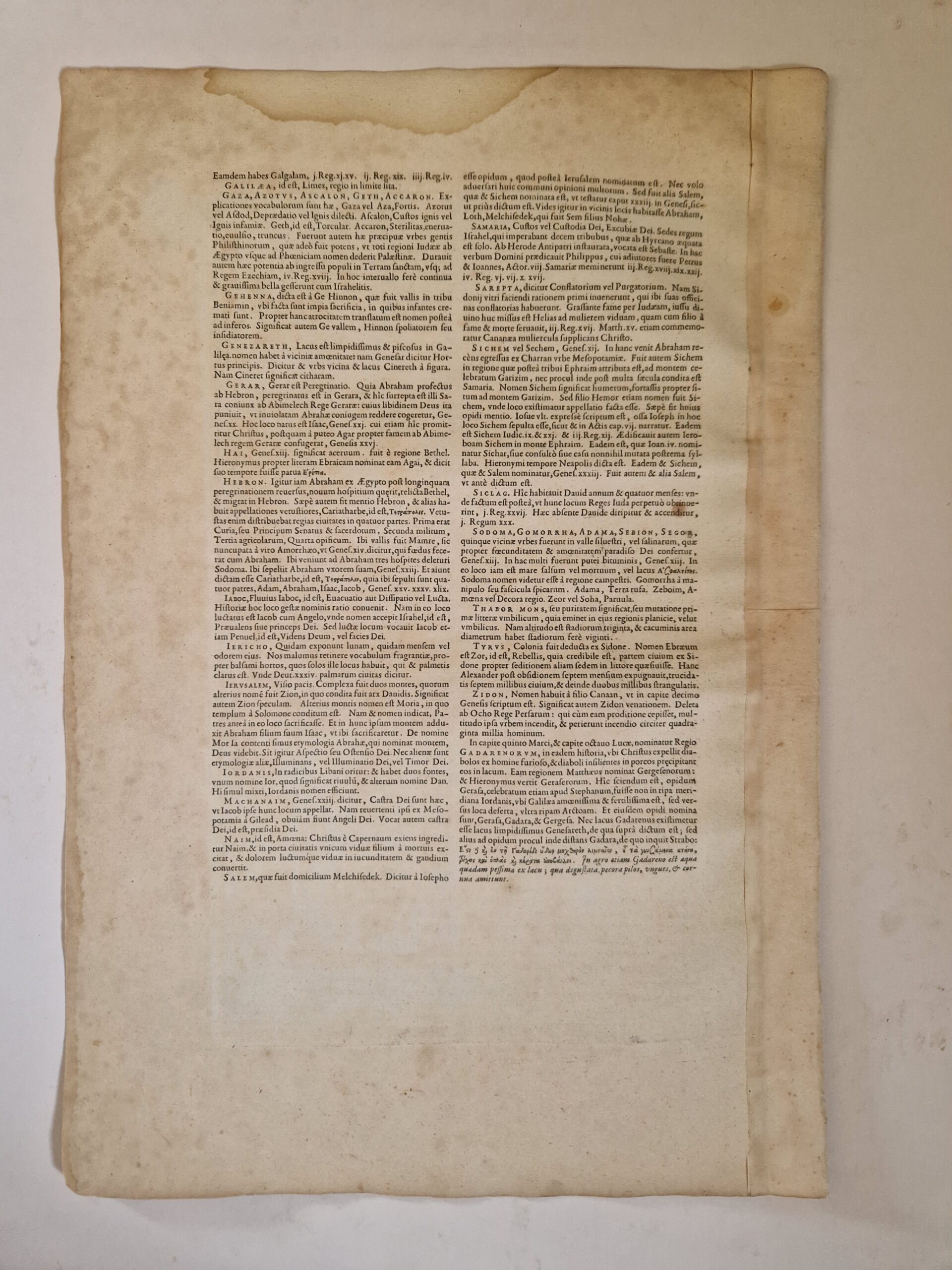
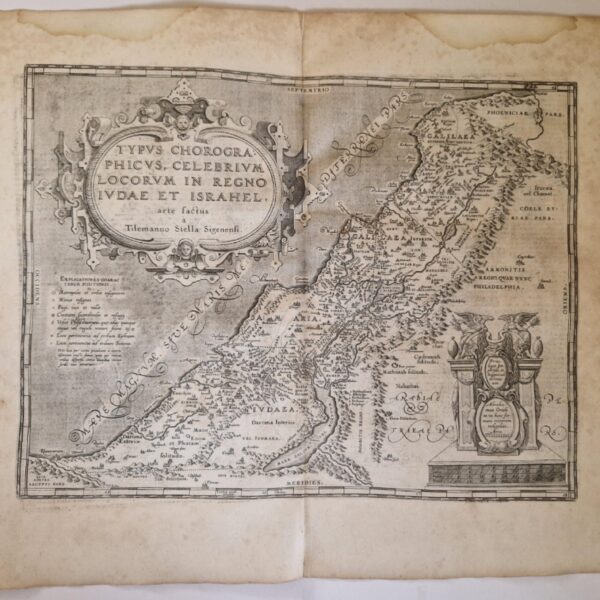
Ortelius – Parergon – Middle East – Holy Land – Iudaea, et Israhel/ Typus Chorographicus, Celebrium Locorum in Regno Iudae et Israhel.


Ortelius – Parergon – Middle East – Holy Land – Iudaea, et Israhel/ Typus Chorographicus, Celebrium Locorum in Regno Iudae et Israhel.
£500.00
Description
copper engraved map, plate size 35 x 46 cm; centrefold as issued and slightly warped; split/ tear lower c’fold but not affecting image; light patina; some foxing; some waterstaining; additional creases along centrefold; lower right corner missing; some off-set; o/w good cond.
The map depicts the Middle East and Holy Land from Ortelius’ Parergon atlas, published in 1624, with Latin text on verso.
While the ‘Theatrum Orbis Terrarum’ is famous for being the first “modern” atlas of the contemporary world, the ‘Parergon’, ie Parergon sive Veteris Geographiae aliquot Tabulae, is Abraham Ortelius’s masterpiece of historical and biblical geography.
The name ‘Parergon’ comes from the Greek word for “supplement” or “by-work,” reflecting its origin as an appendix to the main Theatrum. However, Ortelius himself considered it his greatest scholarly achievement.
The maps were all hand-drawn by Ortelius himself based on his deep study of classical literature, archaeology, and the Bible. They are significantly more decorative and ornate than those in the ‘Theatrum’, often featuring elaborate cartouches, mythological figures, and scenes from history. The maps represent the world not as it was in the 16th century, but as Ortelius believed it appeared in antiquity.
The atlas grew over time. It started with just 3 maps in 1579 and expanded to 55 plates in later editions. Its content generally falls into three categories: Classical Antiquity, Biblical Geography and Mythology & Legend.
Though the Parergon was occasionally published as a standalone volume, notably in 1595 and 1624, it was most commonly found bound at the back of the ‘Theatrum’.
A dense, scholarly text accompanied each map on the verso where Ortelius cited his ancient sources, ie Herodotus, Pliny, and Strabo. It was designed for a humanist audience—the elite scholars and collectors of the Renaissance who were obsessed with reconciling the geography of the Bible and the Classics with the newly discovered world.
Related products
-

 Quickview
-
 Quickview
-
 Quickview
-
 Quickview
Reviews
There are no reviews yet.